
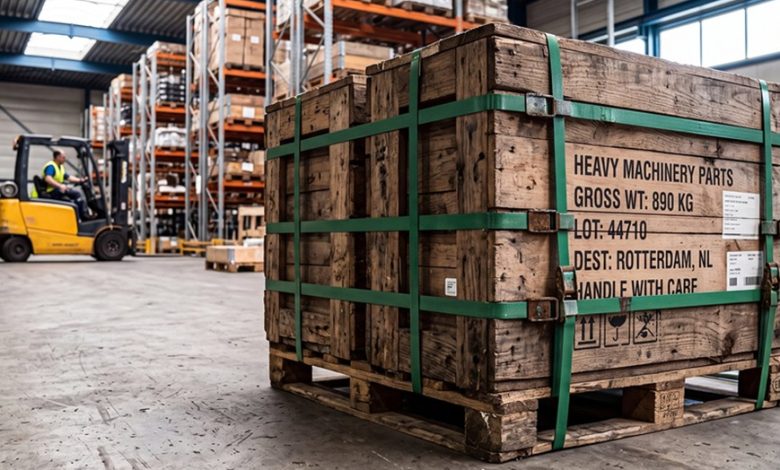
Procurement managers comparing these two usually start from unit cost, where timber wins comfortably and conclusively, and the comparison changes shape once reuse, compliance handling, and what happens at destination enter the calculation. Neither option is better across the board, which is why facilities handling varied equipment generally end up using both. Steel framing suits certain movement profiles, and timber suits others, and the deciding factors are usually how many times the packaging will travel and what the receiving end actually does with it on arrival. Three trade-offs cover most of what matters when specifying packaging for oil and gas logistics in Singapore.
1. Unit Cost Against Reuse Across Multiple Movements
Custom timber crates cost considerably less to fabricate and are generally treated as single-use, dismantled at destination and disposed of or sold for scrap value.
Steel framing costs substantially more upfront and is built to return and be reused, in some cases across many movements over several years. Where equipment rotates between a shore base and offshore installations, or where the same items move repeatedly for maintenance and return, that reuse changes the economics materially rather than marginally, and the higher initial cost is recovered within a few cycles.
The calculation depends entirely on whether return logistics are practical. A steel cradle that must return empty across a long route carries freight cost in both directions, and where return is not realistic for commercial or operational reasons the reuse advantage disappears and the higher unit cost is simply higher cost with nothing offsetting it. Establishing whether return movements are genuinely part of the plan, rather than theoretically possible, is the first thing worth settling.
2. ISPM-15 Compliance and Handling at Borders
Timber packaging crossing borders requires treatment and marking under international phytosanitary requirements, and non-compliant material can be refused entry, treated at the port at the shipper’s cost, or returned entirely, any of which disrupts a delivery schedule that was built around arrival.
Wooden crates in Singapore fabricated for export should carry correct treatment marking applied by an authorised facility, and confirming this at the point of manufacture rather than discovering a problem at the port is where the risk is actually managed. Steel framing sits outside those requirements entirely, which removes both a documentation step and a failure mode, and for shippers moving frequently through multiple jurisdictions that simplification carries value beyond the compliance question itself.
Requirements vary by destination and are revised periodically, so verifying current requirements for the specific route rather than relying on what applied to a previous shipment is worth doing regardless of which material is chosen.
3. Protection Characteristics and What the Equipment Actually Needs
Timber crates can be built fully enclosed, which protects against weather, dust, and handling damage, and they readily incorporate internal bracing, cushioning, and barrier wrapping for items that need more than restraint.
Steel framing is typically open or only partially enclosed, providing structural protection and secure restraint while leaving the equipment more exposed to the environment. For robust items that are entirely adequate, and the open construction allows visual inspection during transit and at handover without unpacking anything.
The question to answer is what the equipment is actually vulnerable to. Where the risk is impact, crushing, and movement during handling, either approach manages it with correct design. Where the risk is moisture ingress, salt air during a sea voyage, or contamination, enclosure becomes the requirement and the framing material is secondary to how the package is built around the item.
Specifying Against the Movement Profile Rather Than the Item
The useful analysis begins with how the equipment will actually move: whether this is a one-way export or part of a rotating cycle, how many handling and transfer points are involved, what the destination does with packaging on arrival, whether storage at destination is covered or exposed, and whether return is commercially practical.
With that established, the choice frequently resolves itself without much further debate. Single-direction export of equipment that stays at destination favours timber comfortably; rotating equipment on an established route with practical return logistics favours steel. Mixed approaches across a fleet are common and sensible, since applying one standard to everything over-specifies some movements and under-protects others. Discussing the movement profile with a packaging supplier, rather than simply requesting a quotation against dimensions and weight, tends to produce a recommendation that reflects the actual logistics rather than the item in isolation.
Contact Sin Chew Woodpaq to discuss your equipment’s movement profile and which packaging approach would suit it.