
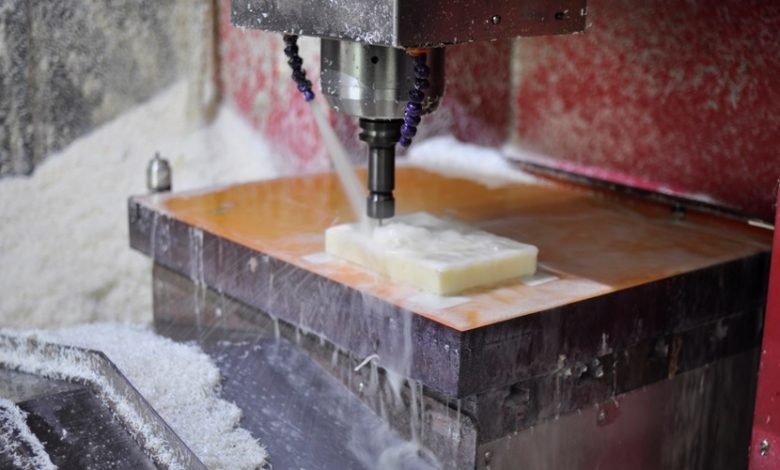
Fixtures do more than simply hold the workpiece in place. Clamping position, support method, and clamping force affect the workpiece’s rigidity and stress state during machining, which can influence vibration, tool marks, dimensional accuracy, and springback after unclamping. This is especially true in CNC metal machining, where cutting forces and clamp pressure interact in ways that can quietly work against the tolerance a part was designed to hold.
Clamp Force Must Hold the Part Without Distorting Its Final Geometry
Clamp force is a balance, not a maximum to reach for. Too little force lets the part shift under cutting pressure, producing chatter and inconsistent tool marks; too much force elastically deforms the workpiece before the tool ever touches it, so material gets removed while the part is bent into a shape it doesn’t naturally hold. Once the clamp releases, the part relaxes toward its free-state geometry and that new shape is often no longer within tolerance. For example, a thick piece of steel will absorb large amounts of clamping force with very little deformation. On the other hand, a thin piece of aluminum will deform greatly under the same amount of clamping force. Therefore, the same amount of clamping force applied to two parts could result in one being properly held and the second being distorted.
WayKen Rapid Manufacturing treats the clamping forces as variables that need to be controlled and not maximized. This is especially true when dealing with thin aluminum enclosures that will distort under excessive clamping force prior to even making the first cut. In reality, controlling clamp force is typically accomplished through measurement and not guesswork. For example, using a small percentage of normal clamping torque and increasing it until the part moves when cutting instead of applying maximum torque out of fear of failure. Additionally, placing clamps on the most rigid area of the part first and then working outward helps to distribute stress evenly across all areas of the geometry, regardless of how uniform they may be.
Support Location Determines Rigidity and Surface Finish During Cutting
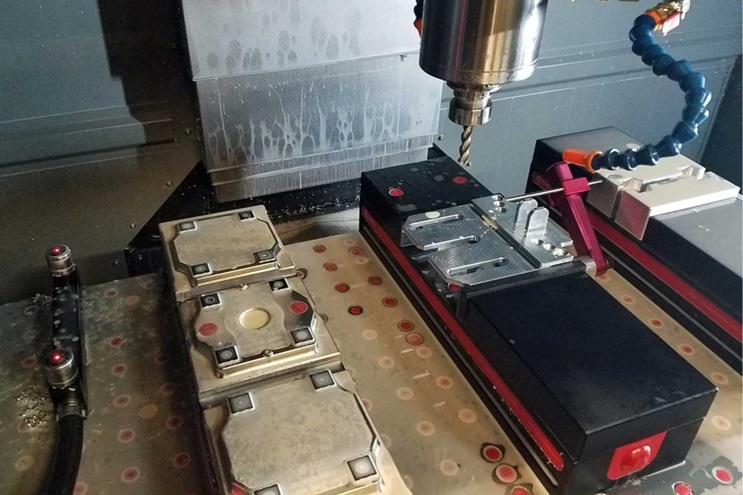
Where a fixture supports a part matters as much as how hard it clamps. If support doesn’t sit directly beneath the zone the tool is cutting, the workpiece has room to flex locally away from the cutting force, and that small deflection shows up as chatter marks, inconsistent surface finish, or a slight dimensional taper across an unsupported span. A fixture that looks adequate from the outside can still leave exactly the wrong area unsupported.
On multi-surface aluminum parts with deep pockets or long unsupported spans, WayKen rapid manufacturing fixtures directly beneath the active machining zone rather than relying on edge clamping alone, since edge support does little to stop a wall from deflecting under a tool working near its center. For thin, flat sections, distributing clamp force over a wider contact area through soft jaws shaped to the part or a vacuum fixture on a large flat face reduces the local pressure that causes distortion in the first place, without sacrificing the rigidity needed to hold position during the cut.
Stable Datums and In-Process Checks Prevent Error Between Setups
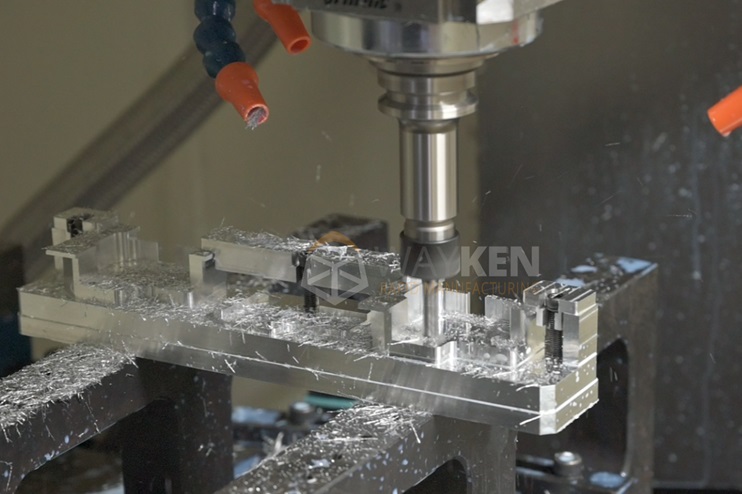
One of the most neglected aspects of precision CNC metal machining is maintaining a consistent datum during multiple setups; this is due to the fact that even a well-fastened component will deviate beyond tolerance limits when its reference points are displaced between operations. Each time a part is re-positioned for an operation, the new set-up must re-create the exact reference surfaces utilized by the preceding set-up. If the process for establishing these surfaces is inconsistent, then the resulting dimensional errors compound with each successive setup.
Using in-process checks to inspect dimensions after roughing instead of waiting until all parts have been machined allows operators to identify springback resulting from relieving internal stresses in materials while the part is still large enough to be corrected using a short finishing pass. Waiting until the final inspection for the same type of error typically renders the parts unusable. WayKen Rapid Manufacturing uses in-process check methods; measurements are taken before and after roughing passes and prior to the first finishing pass, allowing for adjustments made to the finish passes rather than re-machining a completed part.
Conclusion
Clamping strategy is inseparable from surface finish and dimensional stability. Treating clamp force, support location, and datum consistency as controlled variables rather than defaults is what keeps precision CNC metal machining repeatable from the first part in a batch to the last.