
Dams rank among the most consequential pieces of infrastructure in the country. They store drinking water, generate electricity, control flooding, and irrigate farmland, often while sitting directly upstream from homes, schools, and entire towns. When a dam performs as designed, almost nobody notices it. When one fails, the consequences can be sudden and catastrophic. Understanding how and why U.S. dams have failed over the past century and a half offers a clearer picture of why dam safety remains such an active concern today.
The Toll Before Dam Safety Laws Existed
For most of American history, dams were built with little regulatory oversight. The earliest catastrophic failures on record occurred long before any state or federal agency had the authority to inspect them.
On the morning of May 16, 1874, the 43-foot Mill River Dam above Williamsburg, Massachusetts gave way, killing 138 people, including 43 children under the age of ten. At the time, it stood as the deadliest dam failure the country had seen. That record did not last. Fifteen years later, on May 31, 1889, the South Fork Dam nine miles upstream of Johnstown, Pennsylvania collapsed after a period of heavy rain, sending a wall of water into the city below. The disaster killed more than 2,200 people, more than one in five Johnstown residents at the time, and destroyed roughly 1,600 homes, making it one of the deadliest disasters in American history.
Additional failures followed in Arizona, Tennessee, Oregon, North Carolina, Texas, Virginia, and West Virginia around the turn of the century, prompting a handful of states to pass early dam safety legislation. Then, in March 1928, the St. Francis Dam north of Los Angeles collapsed just hours after an inspection had found it structurally sound. The failure killed roughly 600 people and became a landmark event in dam safety history, spurring new legislation not just in California but in neighboring states as well. Even so, most of the country still had no substantive dam safety laws on the books.
The 1970s: A Decade That Changed Everything
It took a string of disasters in a single decade to finally force nationwide reform. Within roughly five years, five separate dam failures killed hundreds of people and reshaped how the country regulates dams.
In February 1972, a coal-waste impoundment at the head of Buffalo Creek Valley, West Virginia failed, killing 125 people and destroying more than 500 homes, with total damages exceeding $400 million. Just months later, in June 1972, the Canyon Lake Dam in Rapid City, South Dakota failed as well, with an estimated 33 to 237 fatalities and damages topping $60 million, including the destruction of 1,335 homes.
The losses continued. On June 5, 1976, the Teton Dam in Idaho failed, killing eleven people and causing more than a billion dollars in property damage, an almost unheard of figure for a dam failure at the time. The following year brought two more tragedies within months of each other: the Laurel Run Dam in Pennsylvania failed on July 19 and 20, 1977, killing over 40 people, and on November 6, 1977, the Kelly Barnes Dam above Toccoa Falls, Georgia failed, killing 39 college students and staff.
The Toccoa Falls tragedy proved to be the turning point. President Jimmy Carter directed the U.S. Army Corps of Engineers to inspect the nation’s non-federal high-hazard dams, a project known as the Phase I Inspection Program that ran from 1978 to 1981. Its findings led most states to establish their own dam safety programs and ultimately resulted in the creation of the National Dam Safety Program, which today supports dam safety efforts in 49 states. Alabama remains the only state that has yet to pass dam safety legislation.
What Actually Causes a Dam to Fail
Modern dam failures rarely come down to one dramatic cause. According to the Association of State Dam Safety Officials, most failures trace back to one of five underlying problems.
Overtopping happens when water spills over the top of a dam, often because a spillway was undersized, blocked by debris, or the crest of the dam had settled over time. This is the single most common cause of failure, responsible for roughly a third of all dam failures nationwide.
Foundation defects, including settlement and slope instability, account for close to another third of failures. A dam is only as strong as the ground it sits on, and problems in that foundation can take decades to surface.
Cracking can develop from the ordinary settling that every dam experiences over its lifespan, and if left unaddressed, cracks can widen into serious structural weaknesses.
Inadequate maintenance and upkeep compounds nearly every other failure mode on this list. A dam that is properly inspected and maintained can often catch small problems before they become large ones.
Piping, responsible for roughly a fifth of U.S. dam failures, occurs when seepage moves through a dam without being properly filtered, gradually carrying soil particles away and forming internal voids or sinkholes within the structure. This kind of seepage often develops around pipes and spillways, through animal burrows, along the roots of woody vegetation, or through cracks in the dam and its foundation.
Recent Failures Show the Risk Has Not Gone Away
While large-scale, fatal dam failures have become far less common since the reforms of the late 1970s, dams have continued to fail in the decades since, and two recent incidents illustrate how aging infrastructure and deferred maintenance still carry real consequences.
On May 19, 2020, following several days of heavy rain, the 96-year-old Edenville Dam in central Michigan failed after a section of its earthen embankment gave way. The resulting surge of water traveled downstream and caused the Sanford Dam to fail as well, roughly two to three hours later. Roughly 10,000 residents had already been evacuated as a precaution, a decision credited with saving an estimated 10 to 20 lives even though no deaths ultimately occurred. Total property losses exceeded $250 million, and a later forensic investigation attributed the physical cause of the Edenville failure to static liquefaction rooted in improper construction practices decades earlier, compounded by inconsistent seepage behavior along the embankment and missed opportunities for earlier repairs. The dam’s owner was later ordered to pay roughly $120 million in damages, though the state has had little success collecting given the owner’s subsequent bankruptcy filing.
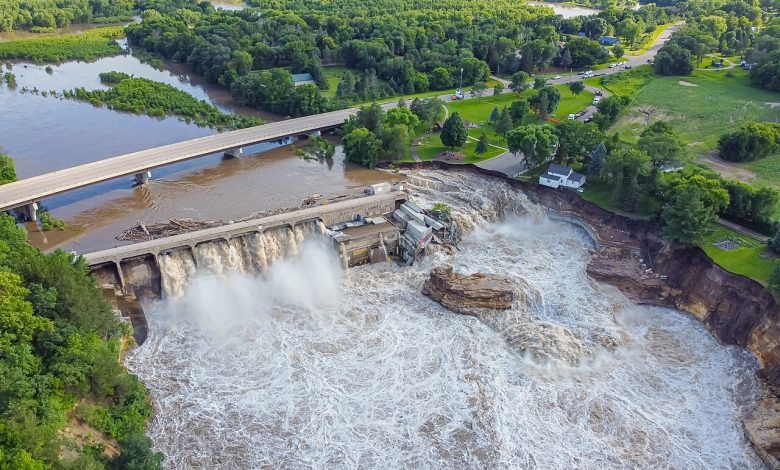
Four years later, on June 24, 2024, the Rapidan Dam in Blue Earth County, Minnesota suffered a partial failure of its west abutment after weeks of unusually heavy rainfall across the region. An Xcel Energy substation at the dam site, serving about 600 customers, washed away as the river cut a new channel around the structure. While officials stopped short of evacuating the surrounding area, a nearby home eventually collapsed into the river as erosion undermined the bluff beneath it. The 114-year-old dam remained structurally intact overall, but the incident renewed national attention on the sheer number of aging dams still operating well past their original design life.
The State of Dam Safety Today
The country’s dam infrastructure has not aged gracefully. The National Inventory of Dams, maintained by the U.S. Army Corps of Engineers, lists more than 92,000 dams with an average age of 65 years, and nearly 17,000 of those are classified as high-hazard potential, meaning their failure could result in loss of life. As of the most recent count, roughly 15 percent of the nation’s high-hazard dams, more than 2,500 structures, were considered to be in poor or unsatisfactory condition.
The financial picture is similarly daunting. A 2025 estimate from the Association of State Dam Safety Officials put the cost of rehabilitating the nation’s nonfederal dams at $165.2 billion, with just the most critical repairs totaling an estimated $37.4 billion. Staffing has not kept pace with the scale of the problem either, since a single state dam safety official is responsible on average for overseeing 190 existing dams, leaving many inspections and maintenance projects delayed.
There are signs of progress. In the American Society of Civil Engineers‘ 2025 Infrastructure Report Card, the nation’s dams improved from a D to a D+, part of a broader uptick that pushed the country’s overall infrastructure grade to a C, the highest mark ASCE has issued since it began publishing the report in 1998. Even so, the report specifically pointed to the Edenville Dam failure in 2020 and the Rapidan Dam failure in 2024 as reminders of what can happen when dam maintenance is deferred for too long.
Why the History Still Matters
From January 2005 through June 2013 alone, state dam safety programs reported 173 dam failures and another 587 incidents that would likely have resulted in failure without intervention. Multiply that pace across nearly 150 years of dam-building in every state in the country, and the record of U.S. dam failures becomes less a list of isolated tragedies and more a pattern with recognizable warning signs: undersized spillways, unstable foundations, unmonitored seepage, and maintenance that gets pushed off for one more budget cycle.
The Association of State Dam Safety Officials maintains a public database of dam failures and incidents (DamSafety.org/Incidents) along with a dedicated site of case studies and lessons learned at DamFailures.org, both intended to help engineers, regulators, and dam owners recognize these warning signs before they become the next entry on the list. Given how many of the country’s dams are now well past middle age, that kind of institutional memory may be one of the more valuable tools available for preventing the next failure rather than simply investigating it afterward.